Organizing Your Job Search
The relationship-first playbook to organize your job search and land your next role with less stress.

Credits
Original Authors:
Kevin Sun
Matthew Silberman
Introduction

Beyond applications: why relationships matter
In today’s competitive job market, submitting applications online is just one piece of the puzzle. Studies show that up to 70% of job seekers find success through networking rather than cold applications (LinkedIn). Building and nurturing relationships, whether with former colleagues, alumni, or new connections, can unlock opportunities that never get posted publicly.
But there’s a catch: while we’re taught how to write résumés and answer interview questions, we’re rarely taught how to track, organize, and nurture the human side of the job search. The coffee chats, the follow-ups, the casual “just checking in” emails? These are easy to forget but often the most important.
Today, your next role is likely to come from a friend-of-a-friend, a warm introduction, or a thoughtful follow-up. Success comes not just from what you apply to, but who you stay in touch with, how you maintain momentum, and why people remember you when an opening comes up.
Why this guide, and why Dex
This guide is designed to help you build a clear, consistent, and people-centered job search with the help of Dex, a personal CRM built for relationships.
But this isn’t a product walkthrough. It’s a strategy-first guide. One grounded in the real-world experience of jobseekers who’ve been through the process, felt the stress, and come out the other side more connected than when they started.
Throughout, we’ll show how Dex can support that process, not with flashy tools, but with simple, thoughtful systems:
Gentle nudges to follow up.
Smart ways to segment your network.
Context that helps you show up prepared every time.
If you’ve ever said, “I should really follow up with that person,” and then didn’t, this guide is for you.
What you’ll get
You won’t find generic résumé tips or one-size-fits-all email templates here.
Instead, you’ll learn how to:
Set up a job search system that actually helps you think clearly.
Prioritize the right relationships and opportunities, not just the ones in your inbox.
Track progress without relying on memory.
Show up more prepared, more consistent, and more human in every interaction.
And most importantly, you’ll walk away with a method for building a job search that doesn’t just land you a job. It strengthens your professional community for the long haul.
Build Your Job-Search Command Center
Lay the foundation before you sprint
Before you start firing off résumés or requesting intros, take a step back and build the foundation to support your search. A job hunt isn’t just a flurry of applications. It’s a weeks- or months-long process of tracking conversations, following up with people, and revisiting opportunities at just the right time. You need a system.
Creating a simple but intentional “command center” gives you the clarity to focus on the right opportunities and the confidence to follow through on them. You won’t need to rely on memory, sticky notes, or scattered spreadsheets.
Start by centralizing your relationships
Most job seekers underestimate how many relationships already exist in their corner. Mentors, former colleagues, friends of friends, even a college connection who works at your dream company. But if those people live in separate inboxes, calendars, and DMs, they’re impossible to act on.
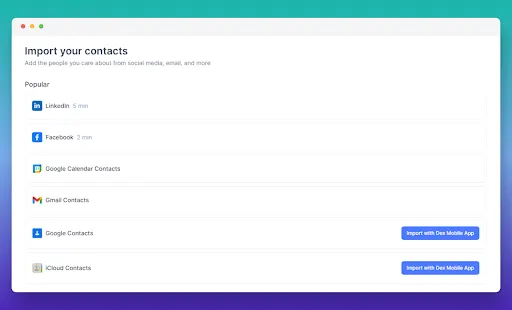
Dex can help. Use Dex’s contact import feature to pull in relationships from LinkedIn, Gmail, your calendar, and more. It automatically de-duplicates and merges profiles so you have a clean slate. You don’t need to sort everyone immediately. Just start with centralization.
Think of it like organizing your kitchen before cooking. You’re not deciding the whole menu yet. You’re just making sure your tools and ingredients are where you can find them.
Add structure with tags and groups
Once your contacts are in one place, add just enough structure to help you navigate your network. You don’t need to tag everyone. Focus on the people who matter most to your search right now.
Use tags like “Hiring Manager,” “Referral Potential,” “Target Company,” or “Alum, CMU” to mark key traits.
Use groups to track categories such as “Warm Intros,” “People at X Company,” or “Vouched Referrals.”
Why this matters: When opportunities come up, you won’t waste time wondering who to reach out to or how you know them. You’ll be able to act fast and intentionally. Whether it’s sending a follow-up or making an ask, you’ll move with confidence and clarity.

Set lightweight, regular follow-ups
One of the most common job-search regrets is letting a warm lead go cold. Not because of a lack of interest. Just because life and stress got in the way.
That’s where smart, non-intrusive reminders come in. You’re not scheduling a dozen coffee chats. You’re simply giving yourself a gentle nudge to stay in touch, send a check-in, or loop back when the timing feels right.
Dex can help: Apply a default 30-day follow-up cadence to your tagged job search contacts. For key people, like someone who told you to reach back out next month or a former boss at your dream company, you can set custom reminders based on your goals.
This isn’t automation for automation’s sake. It’s a system that helps you keep promises to yourself, a lightweight way to stay consistent, intentional, and present throughout your search.

Clarify What You’re Aiming For
Define your role-industry-company matrix
Most job seekers want to “keep options open,” but specificity is power. The more clearly you can define what you’re looking for, and where, the easier it is to pursue the right people and roles with intention.
Break it down into three dimensions:
Roles: What titles or responsibilities do you want?
Industries: Where do you want to apply those skills?
Companies: What organizations fit your criteria (mission, size, location, etc.)?
Turn goals into contact lists
Once you’ve defined your matrix, you can start identifying who might help you get there, and organize accordingly.
Try this:

Build Dex views around your strategy: Use filters and tags in Dex to group contacts by industry or geography, for example, “MIT Alumni” or “Apple Software Designers.” Create a wishlist group: Add companies you’re excited about, then populate it with relevant contacts—employees, recruiters, alumni, etc.
This lets you stay focused when you’re reaching out or following up, instead of getting lost in a sea of contacts.
Why this matters: Job hunting is like campaign strategy. You want to invest more energy into the people and opportunities that actually move you closer to your goals, not just what happens to appear in your feed.
Map and Segment Your Network
Once you’ve gathered your contacts, start spotting patterns:
Who’s working in your industries of interest?
Who recently changed roles or moved companies?
Where do you have clusters of people in one city or one company?

Use map view to spot regional clusters
If you’re planning a move or just want to prioritize in-person meetings, Dex’s map view can show where your network is physically located.
Celebrate title changes to stay top-of-mind
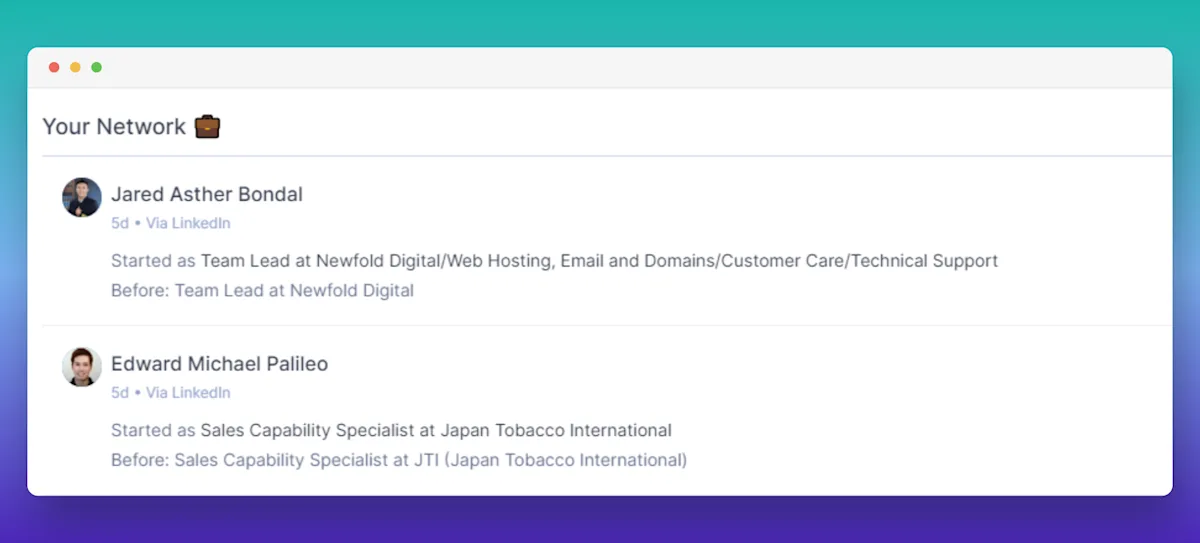
When a contact gets promoted or lands a new role, reach out. A “Congrats!” message is a natural way to reconnect, especially if you haven’t talked in a while. Dex can notify you when someone changes jobs, so you can stay in the loop without living on LinkedIn.
Pro tip: The best networking doesn’t look like “networking.” It looks like catching up, learning something, and being human.
Run Your Weekly Outreach Rhythm
Consistency > intensity
Job searches often stall because people feel overwhelmed by outreach. But small, regular action beats big, occasional bursts. One proven rhythm is the 5-5-3 cadence:
Reach out to 5 new people (alums, second-degree contacts, mutuals)
Follow up with 5 existing contacts (from past companies or recent convos)
Nurture 3 long-term relationships (mentors, previous managers)

Dex supports this cadence by making it easy to log, track, and schedule your interactions.
Log notes after each interaction
In Dex, jot down conversation highlights and next steps. Did someone offer to introduce you to their colleague? Did you talk about a specific role or timeline? Logging it while it’s fresh saves you from forgetting and makes your follow-ups 10x better.
Write short post-call summaries so future-you knows what was said.
Set layered reminders effortlessly with Dex Copilot. Just paste your follow-up actions directly from your notes. For example: “Set a reminder for 5/20, follow up on 6/3, and follow up if I don’t hear back by 5/27.” Copilot will take it from there and schedule everything for you.
Try this: After a coffee chat, note down what you learned and what you can offer back. Relationships are a two-way street.
Give your week a simple shape
The 5-5-3 cadence tells you how much to do. It helps just as much to decide when you’ll do it. When outreach, applications, and follow-ups all compete for the same anxious energy, everything feels urgent and nothing feels finished. Here’s a weekly shape many job seekers find sustainable:
Monday: review your pipeline. Open your system, scan last interaction dates, and pick the handful of follow-ups and outreach targets for the week. No sending yet, just deciding.
Tuesday and Wednesday: outreach blocks. Send your 5 new-contact messages and 5 follow-ups in one or two focused sittings. Batching keeps each message thoughtful without letting outreach swallow the whole day.
Thursday: applications and prep. Tailor your résumé for the roles that made the cut, submit, and prep for any upcoming conversations using the notes you’ve logged.
Friday: the weekly review. Spend 20–30 minutes closing the loop. Log any conversations you haven’t captured, archive dead-end opportunities, and jot down one thing that worked this week and one thing you’ll change.
The Friday review is the piece most people skip, and the piece that matters most. Treat it like a meeting with yourself: same time, same place, non-negotiable. To anchor the habit to something bigger, set one or two concrete networking goals for the month and use the review to check your progress against them.
And then, importantly: stop. A search that bleeds into every evening doesn’t move faster, it just burns you out sooner. A defined rhythm gives you permission to rest, because you know when the work will get done.
Track Applications Like a Pro
Don’t let opportunities slip through the cracks
When you’re actively job hunting, things can start to blur fast. You might apply to five roles in one day, talk to three different people across two companies in a week, and forget if the “head of ops” you messaged last Tuesday was at Company A or Company B.
It’s not just about being organized for the sake of tidiness. It’s about giving yourself the mental space to think strategically. So you’re not just applying, but reflecting. So you’re not just reaching out but following through. And so you’re not accidentally ghosting a recruiter who’s actually waiting on your availability.
Why this matters: The most successful job seekers don’t treat the search like a one-time sprint. They treat it like a pipeline. Every conversation and every opportunity becomes a signal, not just about who’s hiring, but about what kinds of environments are a good fit, which skills are in demand, and where you’re gaining traction.
That pipeline becomes difficult to track quickly if you’re relying on sticky notes, Google Sheets, or your inbox search bar. Most tools weren’t designed for the complexity of a modern job hunt. That’s where a purpose-built system can help you shift from being reactive to intentional.
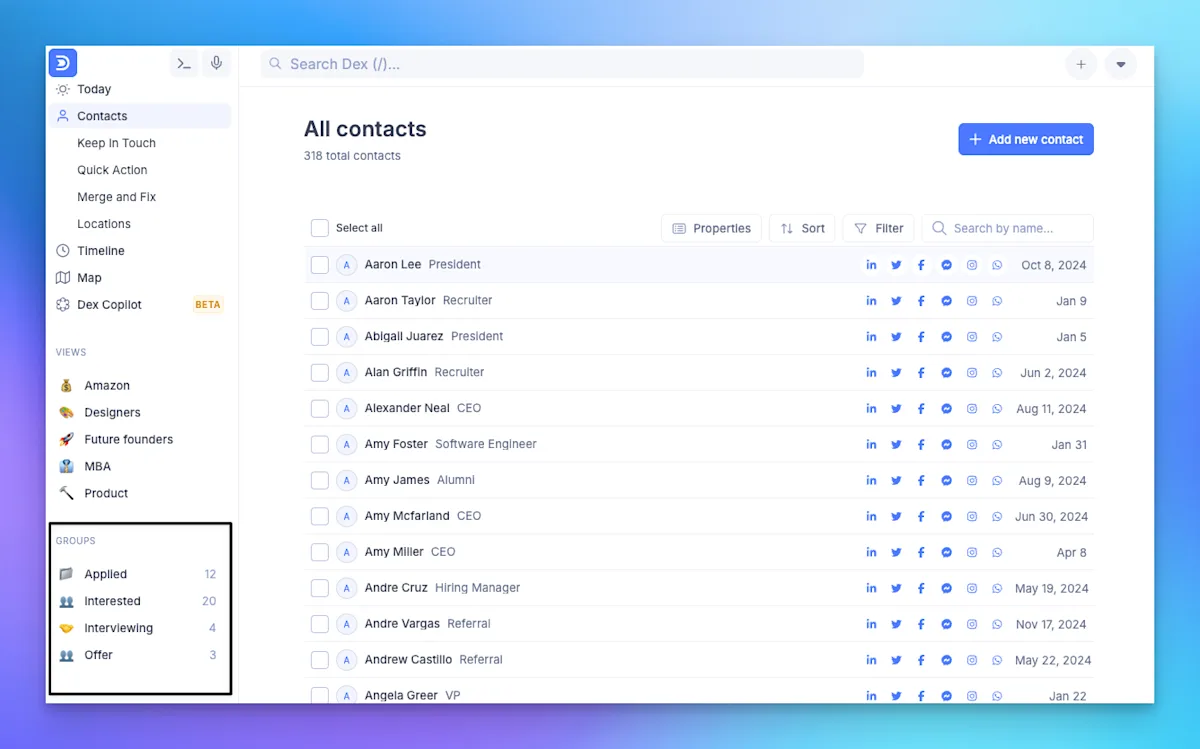
Organize roles by stage, not just company
Start by breaking your pipeline into stages that mirror your progress. For example:
Interested (saved jobs or referred opportunities)
Applied (you’ve sent in your materials)
Interviewing (you’re in active conversation)
Offer or Decision (you’re at the finish line)
This gives you a clear picture of how full your funnel is and whether you need to do more outreach or follow-ups to keep momentum going.
If you’re using Dex, you can create groups to mirror these stages. Each group serves as a container for contacts and conversations (for example, Hiring Managers, Internal Champions, and Referrals) linked to the corresponding role. You’ll always know where things stand.
Keep docs and notes attached to each opportunity
Nothing slows you down more than scrambling for a job description before an interview or rewriting a tailored résumé because you forgot where you saved it. Create a single home for every opportunity. Attach:
The job posting (or paste the full text for keyword reference)
Your résumé version for that company
Notes from past interviews or coffee chats
Follow-up messages you’ve sent
When everything is in one place, prep becomes a matter of minutes, not hours.
Let last interaction dates guide your follow-ups
Sometimes, the most important thing to know is: “Who haven’t I followed up with yet?” Instead of relying on memory or setting 100 individual calendar reminders, let your system show you what’s growing cold.

In Dex, you can sort your pipeline by last interaction date. This brings forward opportunities with no recent movement, gently nudging you to check in, send a thank-you, or close the loop.
Practice pipeline hygiene: archive without agonizing
A pipeline is only useful if it reflects reality. Opportunities that quietly died weeks ago but still sit in “Interviewing” drain attention and morale every time you scan the list. Healthy pipelines get pruned.
A few rules of thumb:
Send one “closing the loop” follow-up before archiving. If you’ve followed up twice with no response, send a final, gracious note. Sometimes it revives the thread; either way, you’ll archive with a clear conscience.
Archive after about three weeks of silence. If there’s been no movement despite your follow-ups, move the opportunity out of your active stages. You’re not deleting it, you’re just clearing your line of sight.
Archive rejections promptly, but keep the people. The role is closed; the relationship isn’t. Log the outcome, send your post-rejection note, and keep the recruiter or hiring manager on a light follow-up cadence. Archiving an application should never mean archiving a person.
Revisit your archive monthly. Companies reopen roles, hiring freezes thaw, and the recruiter who ghosted you in March may be staffing a new team in June. A quick scan often surfaces one or two opportunities worth a fresh touch.
This is emotional maintenance as much as organizational maintenance. A tidy pipeline gives you an honest picture of your momentum, and makes it much easier to see when the top of your funnel needs more outreach.
Real-world insight from a Dex user:
This quote captures the reality of organized job hunting: you still have to do the work, but with the right system in place, that work becomes sustainable. You stop dropping balls. You start showing up more prepared. And your job search becomes something you can actually steer, not something that steers you.
Prepare for Every Conversation
Personalization wins, even in job hunting
People want to help, but they can’t read your mind. That’s why one of the best things you can do in any job-search conversation is to bring clarity by specifying what you’re exploring, what you’re curious about, and how they can help, if they’re open to it.
Before any call, interview, or meeting, take five minutes to review your notes, refresh your memory, and tailor your approach.
It’s also about showing up with curiosity, not an agenda. The best networking conversations aren’t just about jobs; they’re about stories, shared experiences, insights, and advice. People remember those. They want to keep helping people who ask good questions and follow through.
What makes a conversation memorable?
You came prepared with context (their background, shared connections, etc.)
You asked thoughtful questions (not just “can you get me a job?”)
You took notes, and followed up afterward with a thank-you
You showed you listened (and acted on the advice they gave)
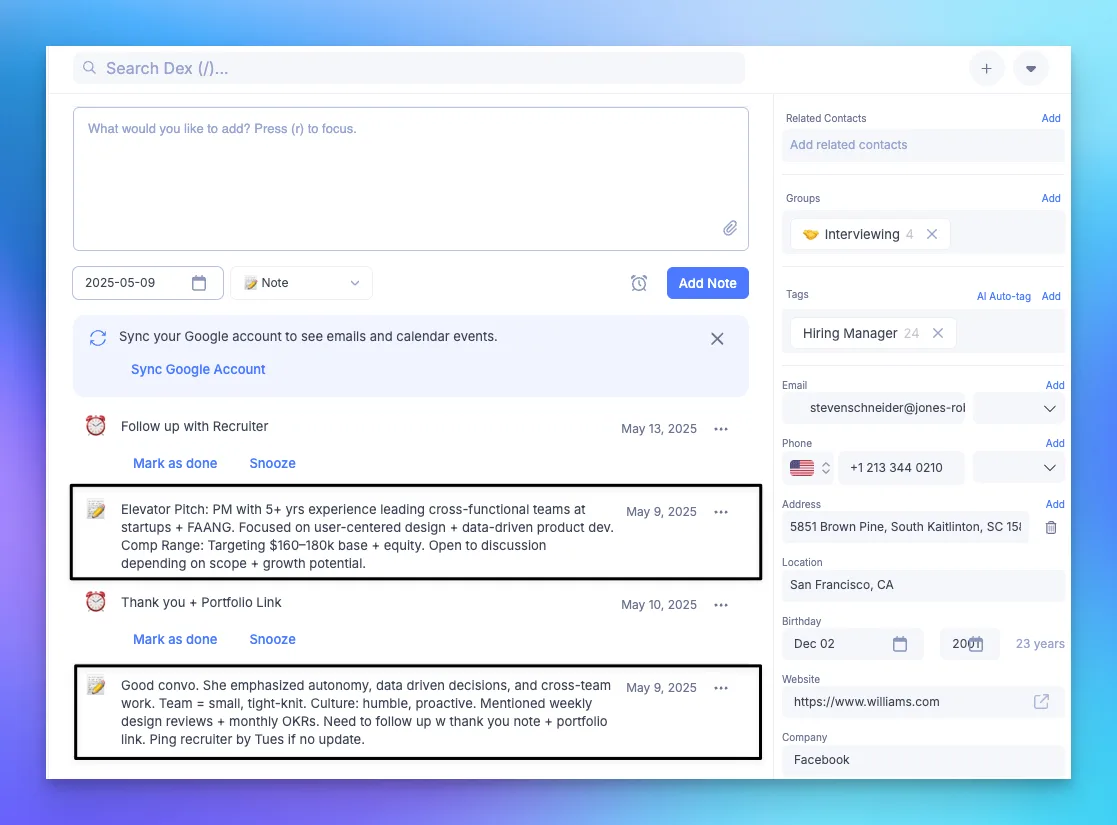
In Dex, you can view a timeline of past conversations, access key notes at a glance, and even keep short blurbs (like your elevator pitch or salary expectations) in the contact’s profile.
Why this matters: You’re not just another résumé in a sea of applications; you’re someone who shows up prepared, remembers the details, and makes others feel seen and heard. That’s the kind of person people want to recommend.
Keep Momentum with Gentle Reminders
When job hunting, it’s easy to get caught up in the rush of applications and interviews, and let important relationships slip through the cracks. To avoid this, schedule a quarterly “Network Health” review to pause and assess how you’re doing. A quarterly check-in, about every three months, balances staying connected without feeling overwhelmed. Relationships don’t usually change dramatically overnight, so this rhythm gives you enough time to build meaningful interactions but also catches any fading connections before they go cold.
Plus, this schedule fits naturally with common business rhythms. Many companies operate on quarterly cycles, which means your outreach is more likely to land when contacts are planning new projects or hiring. Most importantly, a quarterly pause helps you reflect on what’s working, what’s not, and adjust your job search strategy accordingly. Instead of a frantic sprint, your search becomes a thoughtful, steady process.
Try this:
Re-engage cold leads. That hiring manager you met six months ago? The alum you had coffee with during your exploratory phase? Even if nothing came from the initial chat, it’s worth reaching out again. A simple “How have you been?” can restart a conversation naturally. Dex’s contact history, or Timeline view, helps you remember where you left off, so you can pick up without awkwardness.
Protect personal relationships during the grind. The job hunt can easily take over your headspace and time. But don’t let it come at the expense of the people who truly support you, your friends, family, and close peers. Make room to connect with them just for the sake of connection; no career talk needed.
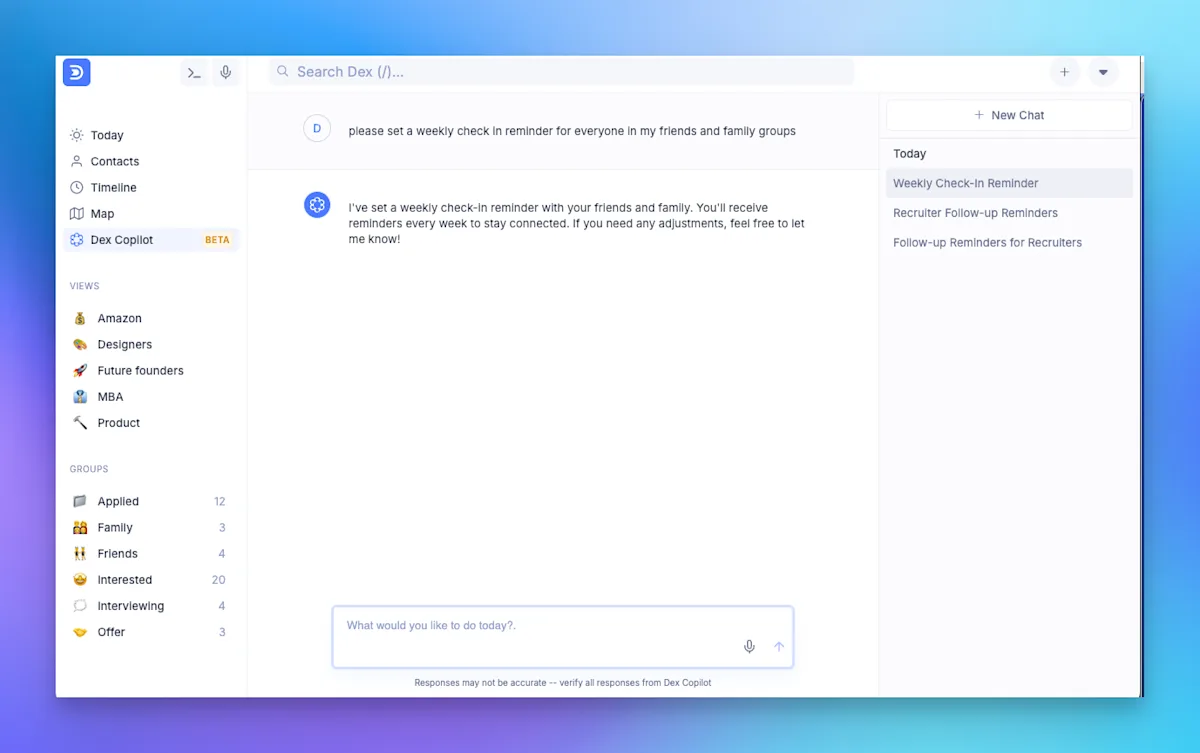
Use Dex Copilot to your advantage. Set follow-up reminders tied to contacts or groups, so you never miss a beat when it comes to nurturing your network, and set those check-in reminders without any hassle.
Follow Up Like a Standout Hire
Here’s a truth that often gets overlooked: the people who get hired aren’t always the ones with the most impressive résumés. They’re often the ones who follow through. Who stay on the radar. Who show they care enough to follow up, even when they haven’t heard back yet.
This doesn’t mean being pushy. It means being present, being intentional, and showing that you’re the kind of person who follows up not just because you want something, but because you value the relationship.
Why this matters: Recruiters and hiring managers are people first. They’re juggling dozens of candidates, meetings, and internal back-and-forths. Even if they liked you, even if your interview went well, they might not remember to update you unless you remind them gently, professionally, and at the right moment.
A thoughtful follow-up isn’t just a ping. It’s a signal of interest. It shows maturity, reliability, and genuine enthusiasm. And it’s often the difference between a missed connection and a next conversation.
Make it timely, personal, and easy to respond to
A good follow-up doesn’t just say “checking in.” It adds value. It reminds them who you are. It makes it easy for them to pick the thread back up.
Try something like:
Hi [Name], I really enjoyed our conversation last week about [specific topic]. I’ve been thinking more about what you shared regarding [challenge or initiative]. If there’s anything else I can send your way, or if there’s a good time to reconnect, I’m all ears. Thanks again for the time and insight!
This tells them: I’m not just waiting. I’m thinking. I care.
The follow-up you send after a rejection matters too
Most candidates drop off completely after hearing a “no.” That’s a missed opportunity.
The way you follow up after rejection shows character and keeps doors open. It might lead to another role down the line, or they might refer you to someone else. (This happens more often than you’d think.)
Try something like:
Thank you again for the opportunity to interview for [role]. Although the outcome wasn’t what I hoped for, I truly valued the chance to learn more about your team and company culture. If anything changes or if there are future roles that might be a better fit, I’d love to stay in touch.
Send it. Mean it. And move forward with your integrity intact.
Bottom line: following up isn’t about “bothering” people. It’s about building momentum and signaling that you’re someone who shows up with intention. Every thoughtful follow-up plants a seed. Some grow into interviews. Some grow into offers. Others grow into longer-term connections that open doors months or years down the line.

Use AI Without Sounding Like Everyone Else
AI tools are now a standard part of the job search, and used well, they’re genuinely helpful: tightening a rambling résumé bullet, surfacing keywords from a job description, or helping you rehearse tough interview questions. Used carelessly, though, they produce the one thing a relationship-first job search can’t survive: messages that sound like they could have been sent to anyone.
Recruiters now read AI-drafted outreach every day, and they’ve gotten very good at spotting it. The tell isn’t the grammar; it’s the absence of anything only you could have written. A useful line to draw:
Let AI help with structure, not substance. Use it to outline, condense, or reword. Don’t let it invent your interest in a company or manufacture enthusiasm you’ll have to fake in the interview.
Feed it your real context. A draft built from your actual notes, such as what you discussed, what they mentioned they’re working on, and what you promised to send, will always beat a draft built from a job posting alone.
Rewrite the first and last lines yourself. Openings and closings carry most of a message’s warmth. If those two lines are unmistakably yours, the middle can borrow help.
Never automate the relationship itself. Bulk-personalized “spray and pray” outreach reads as spam because it is spam. Five genuine messages will outperform fifty generated ones, on LinkedIn or anywhere else.
The irony is that AI has made the fundamentals more valuable, not less. When generic outreach is effortless, a message that references your last conversation and asks a specific question stands out more than ever. AI can polish the words, but the memory and the intent have to be yours.
Reflect and Refine
Job hunting isn’t a one-and-done process: it’s a continuous cycle of learning, adapting, and growing. Each application, conversation, and interview is a data point. The key to success is treating your job search like an experiment, where you analyze what works, what doesn’t, and then adjust your approach accordingly.
Why this matters:
Reflection turns rejection into progress. Every “no” teaches you something, whether it’s about your pitch, your résumé, the types of roles you’re targeting, or the industries you’re exploring.
Without reflection, you risk repeating the same mistakes or missing out on strategies that actually work.
Try this:

Tag outcomes in Dex: Categorize every contact or opportunity by outcome: Offer, Rejection, No Response, or On Hold. This turns your job search into an organized dataset you can analyze.
Look for trends: Are referrals landing you more interviews than cold applications? Is one sector more responsive than another? Tracking these patterns reveals where to focus your energy.
Adjust your follow-up cadence: Maybe your first follow-up emails get responses, but later ones don’t. Or perhaps reaching out too frequently is overwhelming contacts. Refine your timing based on what your network responds to best.
By actively reflecting and refining, you turn your job search into a smart, targeted effort. This approach helps you conserve energy, avoid frustration, and build meaningful relationships that increase your chances of landing the right role.
Keep the Connection Going
Landing the job isn’t the end of the journey: it’s a pivotal moment to reinforce your relationships, close the loop with your network, and set the stage for long-term career growth. The people who helped you along the way, such as referrers, mentors, and connectors, deserve to hear how things turned out.
Why this matters:
People remember how you follow up. A simple “thank you” after you’ve accepted an offer leaves a lasting impression and keeps doors open. Plus, those who supported your job search often turn into long-term mentors, collaborators, or future references. The relationships you nurtured during the job hunt are part of your career capital. Don’t let them go cold.
Try this:
Send thank-you updates. Share the news with contacts who helped you, whether by making introductions, offering advice, or giving referrals. A short message like “Thanks again for your help, I’ve just accepted a role at [Company]!” shows appreciation and keeps the connection alive.
Log the update in Dex. Add a note to each contact’s timeline. This creates historical context for the next time you reconnect.
Set a 90-day cadence for key contacts. You don’t need weekly check-ins, but a quarterly reminder ensures you stay in touch with mentors, advocates, and new colleagues as your role evolves.

Dex recommends using the Keep-in-Touch page when you’re setting up frequencies for multiple contacts. From there, it’s a simple drag and drop. You can also organize reminders by Group.
Protect your network’s momentum. New jobs come with new people, new learning curves, and new time demands, but maintaining your relationships doesn’t need to be overwhelming. With a light structure in Dex, you’ll keep your network warm without burning out.
Common Pitfalls (and How Dex Can Help)
Even the most strategic job searchers can fall into common traps, especially when juggling outreach, applications, interviews, and follow-ups. The good news is that most of these pitfalls come down to one thing: disorganization. And that’s fixable.
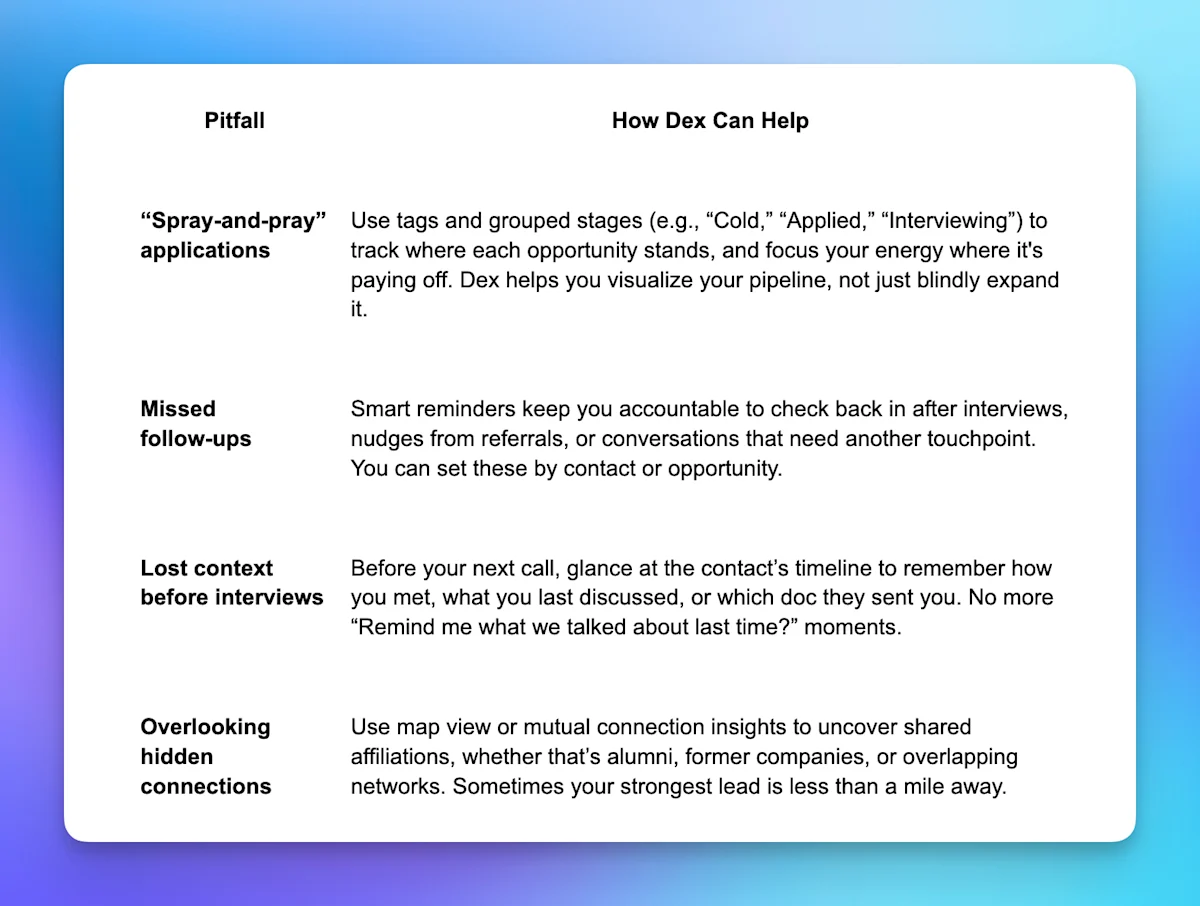
Below are some common challenges job seekers face, along with how Dex can help you sidestep them:
Why this matters:
Job hunting is already hard enough. You don’t need to be brilliant; you just need to be consistent. Avoiding a few key mistakes puts you ahead of most candidates. With a simple system like Dex, that consistency becomes easier, even when life is chaotic.
Final tip: If you’re feeling overwhelmed, start small. Clean up five contacts. Set one reminder. Add a note after each conversation. Little actions compound and build momentum you can count on.
Quick Start Checklist
Set yourself up for a calmer, more organized job search with these five foundational steps:
Install the Dex browser extension. Start capturing context as you browse. Whether you’re viewing a LinkedIn profile, an open role, or a helpful message thread, one click adds it to your system.
Import your contacts. Bring in your connections from LinkedIn, Gmail, Google Calendar, iMessage, or WhatsApp. You don’t have to start from scratch. Dex helps you consolidate the people you’ve already built rapport with, all in one place.
Tag your top 25 warm contacts and set a 30-day follow-up cadence. Identify the friends, mentors, or professional peers you could reach out to today. Tag them and set gentle reminders to stay in touch. This small step alone can open real opportunities.
Create an “Applications” group and add five company contacts you’re targeting. Your job search isn’t just about roles. It’s about people. Start by adding recruiters, hiring managers, or potential teammates from a few of your target companies.
Block 30 minutes each week to review your outreach and update Dex. Consistency matters more than intensity. A weekly calendar block ensures your job search continues to move forward, even during busy weeks.
Relevant Reads & Resources
Want to dig deeper into job search strategies and networking? These resources echo the themes of this guide and offer practical next steps:
“The Power of Networking: Why 70% of Job Seekers Find Success Through Connections”, LinkedIn Pulse — highlights how sustained networking, not random outreach, is the key to landing roles (LinkedIn).
“Your Job Search Is 80% Networking and 20% Applying”, LinkedIn Pulse — underscores the significant impact of relational outreach compared to cold applications (LinkedIn).
“Is Networking Still The Best Way To Land a New Job?”, Forbes — reminds us that networking, while not a magic bullet, remains a critical strategy in today’s job market (Forbes).
“Networking Basics”, GCFGlobal — a primer on strategic outreach, building meaningful connections, and understanding networking fundamentals (edu.gcfglobal.org).
Frequently asked questions
A few questions that come up again and again when people set up their job-search system:
How many applications should I track at once?
Most people can meaningfully manage somewhere between 10 and 20 active opportunities. Beyond that, tailoring suffers and follow-ups slip. It’s fine to have 30 roles in “Interested,” but if 30 sit in “Applied” or “Interviewing” with no follow-up system, quality quietly collapses. When in doubt, cap your active list and let the archive absorb the rest. Depth of attention beats breadth of applications.
How do I organize a job search spreadsheet?
If you’re starting with a spreadsheet, keep it ruthlessly simple: one row per opportunity, with columns for company, role, stage, key contact, last interaction date, next action, and a notes cell. Sort by last interaction date, not alphabetically, so the roles going cold rise to the top. The honest caveat: spreadsheets track roles well and relationships poorly. Once your search involves more than a handful of ongoing conversations, you’ll feel the ceiling. That’s the point at which moving your people into a dedicated system like Dex, where every contact carries their own history and reminders, pays for itself.
How long should a job search take?
There’s no honest universal number: seniority, industry, market conditions, and how targeted your search is all move the timeline. Many searches run three to six months; senior roles and career changes often take longer. Two things are reliably true, though. First, searches driven by warm relationships tend to move faster than cold-application searches, because referrals skip the noisiest part of the funnel. Second, if you’re switching fields entirely, expect a longer runway; our guide to career pivots covers how to bridge that gap through your network. Judge your progress by conversations started and relationships deepened, not by weeks elapsed.
How do I keep track of networking contacts during a search?
Centralize first, then structure lightly: pull your contacts into one place, tag the ones relevant to your search, and set a default follow-up cadence of around 30 days so nobody goes cold by accident. After every conversation, log two things while they’re fresh: what you discussed and what happens next. That habit alone puts you ahead of nearly everyone. For the longer-term practice of staying connected beyond the search, see our guide to the best ways to keep in touch.
When should I follow up after applying or interviewing?
After applying: if you have a human contact at the company, a short note within the first week signals genuine interest; if you don’t, that’s your cue to find one. After an interview: send a thank-you within 24 hours, then follow up about a week after the timeline they gave you passes. Silence usually means busy, not no. One polite nudge is professional; a second, a week later, is still fine. Beyond that, send a gracious closing note and redirect your energy to opportunities that are moving.
Conclusion
At face value, job hunting seems like a means to an end. Get the offer, sign the contract, and move on. But if you zoom out, a different picture comes into focus. The people you meet, reconnect with, and support along the way aren’t just part of getting the job. They are the beginning of a long-term network that will shape the arc of your career.
Whether you’re just starting out, navigating a pivot, or reaching for your next chapter, the truth holds: this process isn’t just about applications. It’s about relationships. Real people who share advice, offer referrals, and open doors, not because they have to, but because they trust you.
That’s why building a simple, sustainable system matters. A system helps you follow through. A habit helps you stay present. Together, they turn scattered effort into a thoughtful rhythm. They help you move through your job search with clarity, connection, and momentum.
This isn’t about hustle. It’s about care. It’s about showing up with intention. That means remembering what mattered to someone in your last conversation, circling back after an interview, and checking in long after the offer is signed. Tools like Dex can’t land the job for you, but they help make sure nothing meaningful slips through the cracks. They support you in staying consistent, thoughtful, and ready for what comes next.
You don’t need to be a networking pro or a CRM expert to make this work. You just need a system you’ll actually use, a rhythm you can stick to, and the belief that relationships are worth investing in.
Start small. Tag a few contacts. Set one reminder. Send one thoughtful follow-up. Over time, those small actions compound into a network that knows you, trusts you, and shows up for you when it matters most.
Because the job offer will come and go. But the people? They’re what lasts.
And that, more than any résumé bullet point, is what turns a job search into a career.